
Many NRIs face a common problem – both India and their host country claim them as tax residents.
The result? Risk of paying tax twice on the same income.
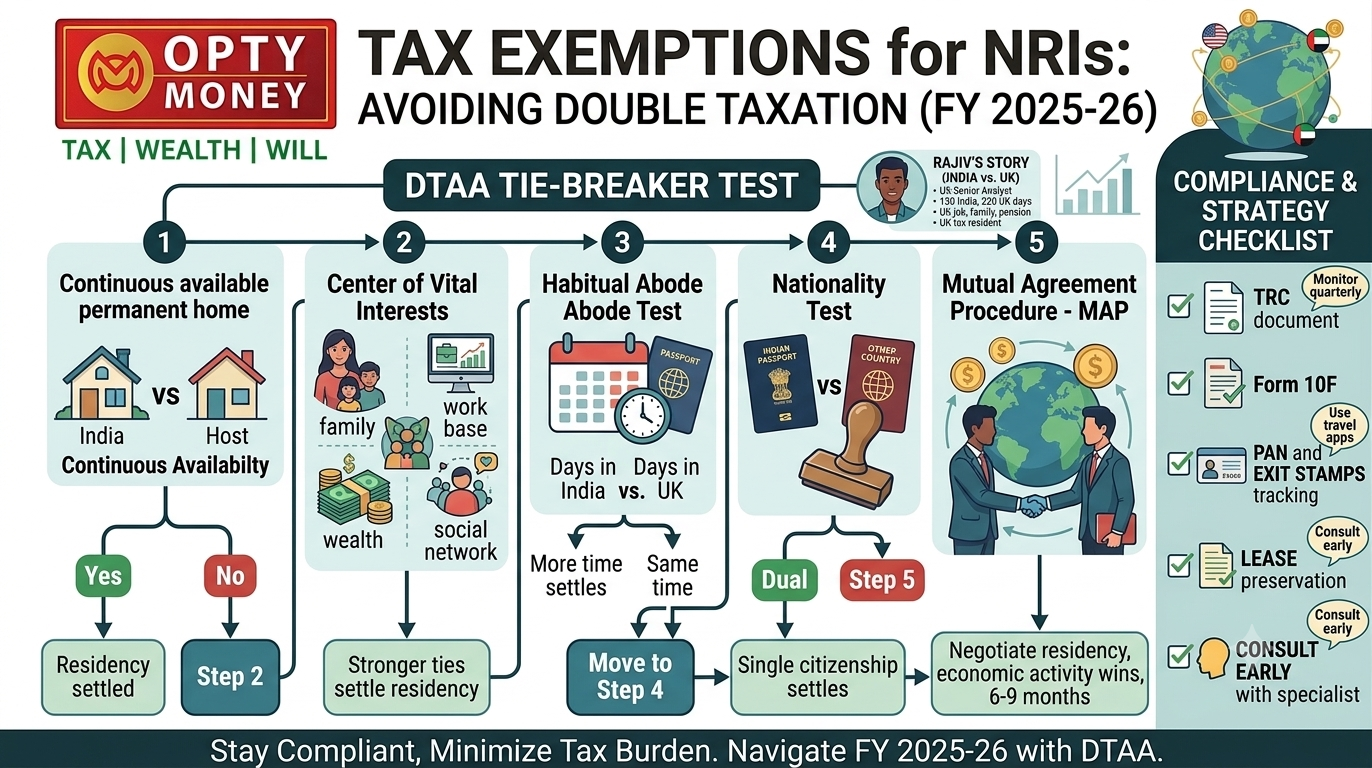
The solution lies in the Double Taxation Avoidance Agreement (DTAA), which uses a 5-step Tie-Breaker Test to decide one country as your exclusive tax home.
Step 1 – The Permanent Home Test 🏠
Where do you have a permanent home (owned or rented) continuously available?
✅ If it’s only in one country, your tax residency is decided immediately.
✅ If both qualify, we move to Step 2 – Determining Your Life’s Economic & Personal Hub.
💬 Over the next few days, We’ll break down all 5 steps with examples and tips so you can plan better and avoid double taxation.
Tomorrow: Step 2 – Determining Your Life’s Economic & Personal Hub
If you have a permanent home in both India and your host country, the DTAA Tie-Breaker Test moves to Step 2 – figuring out where your strongest ties are.
This is called your Centre of Vital Interests and includes:
✅ Family connections – Where do your spouse and dependents live?
✅ Work base – Location of your primary job or business
✅ Investments & assets – Where your wealth is concentrated
✅ Social & professional network – Where you’re most active
📌 The country with the stronger personal and economic ties becomes your exclusive tax home.
If it’s still a tie, we move to Step 3 – the Habitual Abode Test.
Tomorrow: Step 3 – Which Country Feels More Like Home Based on Days Spent
Tax Exemptions for NRIs – Step 3: The Habitual Abode Test 📅
If both your permanent home and life’s economic & personal hub are in both India and your host country, the DTAA moves to Step 3 – the Habitual Abode Test.
This step looks at:
📌 The total number of days you spend in each country during the relevant period.
📌 The country where you spend more time becomes your tax residence.
✅ This is a straightforward, numbers-based assessment – no subjective judgment, just actual presence.
If you spend about the same time in both countries, we move to Step 4 – the Nationality Test.
Tomorrow: Step 4 – When Your Passport Decides Your Tax Home
Tax Exemptions for NRIs – Step 4: The Nationality Test
If your permanent home, economic & personal hub, and habitual abode all fail to clearly decide your tax residency, the DTAA moves to Step 4 – the Nationality Test.
📌 Here, your citizenship determines your tax home.
📌 If you hold only one nationality, the decision is straightforward.
📌 But if you have dual citizenship, this step still may not settle the matter.
When even nationality doesn’t give a clear answer, the process goes to the final step – the Mutual Agreement Procedure (MAP), where tax authorities from both countries decide your residency together.
Tomorrow: Step 5 – When Countries Negotiate Your Tax Residency
Tax Exemptions for NRIs – Step 5: Mutual Agreement Procedure (MAP)🤝
If all earlier DTAA steps – permanent home, economic & personal hub, habitual abode, and nationality — fail to settle your tax residency, it comes down to Step 5: Mutual Agreement Procedure (MAP).
📌 Tax authorities from both countries negotiate under the DTAA to decide your residency.
📌 This process usually takes 6–9 months.
📌 In most cases, the decision favours the country where your economic activity is stronger.
✅ Pro Tips to Strengthen Your Case:
Keep your Tax Residency Certificate (TRC) from the foreign jurisdiction
File Form 10F with your Indian tax return
Maintain lease agreements, property deeds, or proof of residence
Preserve employment contracts, pay slips, and bank statements
Track your travel days using an app or detailed log
The DTAA isn’t just paperwork – it’s your legal shield against double taxation. With the right records and planning, you can protect your income and stay compliant.💬
hashtag#NRI hashtag#TaxExemption hashtag#DTAA hashtag#MutualAgreementProcedure hashtag#DoubleTaxation hashtag#CrossBorderTax
NRI Tax Exemptions in Action – Rajiv’s DTAA Tie-Breaker Story
Meet Rajiv Desai – an Indian citizen working as a senior analyst in the UK.
His situation:
Days in India: 130
Days in UK: 220
Permanent Homes: Family home in Mumbai + rented flat in London
Economic Ties: UK job, UK pension, UK investments, family in London
Tie-Breaker Test Analysis:
1️⃣ Permanent Home Test: Both countries qualify → No decision
2️⃣ Economic & Personal Hub: Stronger ties to UK (family, career, assets) → UK wins
Result:
Rajiv is a UK tax resident, pays UK tax on global income, and claims DTAA relief to avoid Indian tax on his foreign earnings.
✅ Compliance Checklist for NRIs Using DTAA
Tax Residency Certificate (TRC) from the foreign jurisdiction
Form 10F filed with your Indian tax return
Valid PAN and passport with entry/exit stamps
Lease agreements or property ownership documents
Employment contracts and salary statements
Bank & investment account statements
💡 Keep both digital and notarized copies; translate non-English documents
📌 Strategic Recommendations
Monitor continuously: Review stays and ties quarterly to predict shifts in residency
Track religiously: Use travel apps to record your presence in each country
Consult early: Engage a cross-border tax specialist before filing deadlines
Be proactive: Initiate MAP proceedings early if dual residency persists
📍 The Bottom Line
The DTAA Tie-Breaker Test isn’t just a tax rule — it’s your shield against double taxation.
By knowing the steps, keeping proper documentation, and planning ahead, NRIs can navigate FY 2025-26 with confidence, ensuring compliance while minimising tax burden.
hashtag#NRI hashtag#TaxExemption hashtag#DTAA hashtag#DoubleTaxation hashtag#CrossBorderTax hashtag#NRITaxPlanning